



The World Hammer Ball (WHB) is the global governing body for Hammer Ball, and the Hammer Ball Association of India (HBAI) operates under WHB as its national affiliate. We are committed to developing and nurturing Hammer Ball as a recognized sport nationwide. We aim to build a strong sporting culture by organizing district, state, national, and international tournaments, providing training programs, and ensuring fair opportunities for all players.

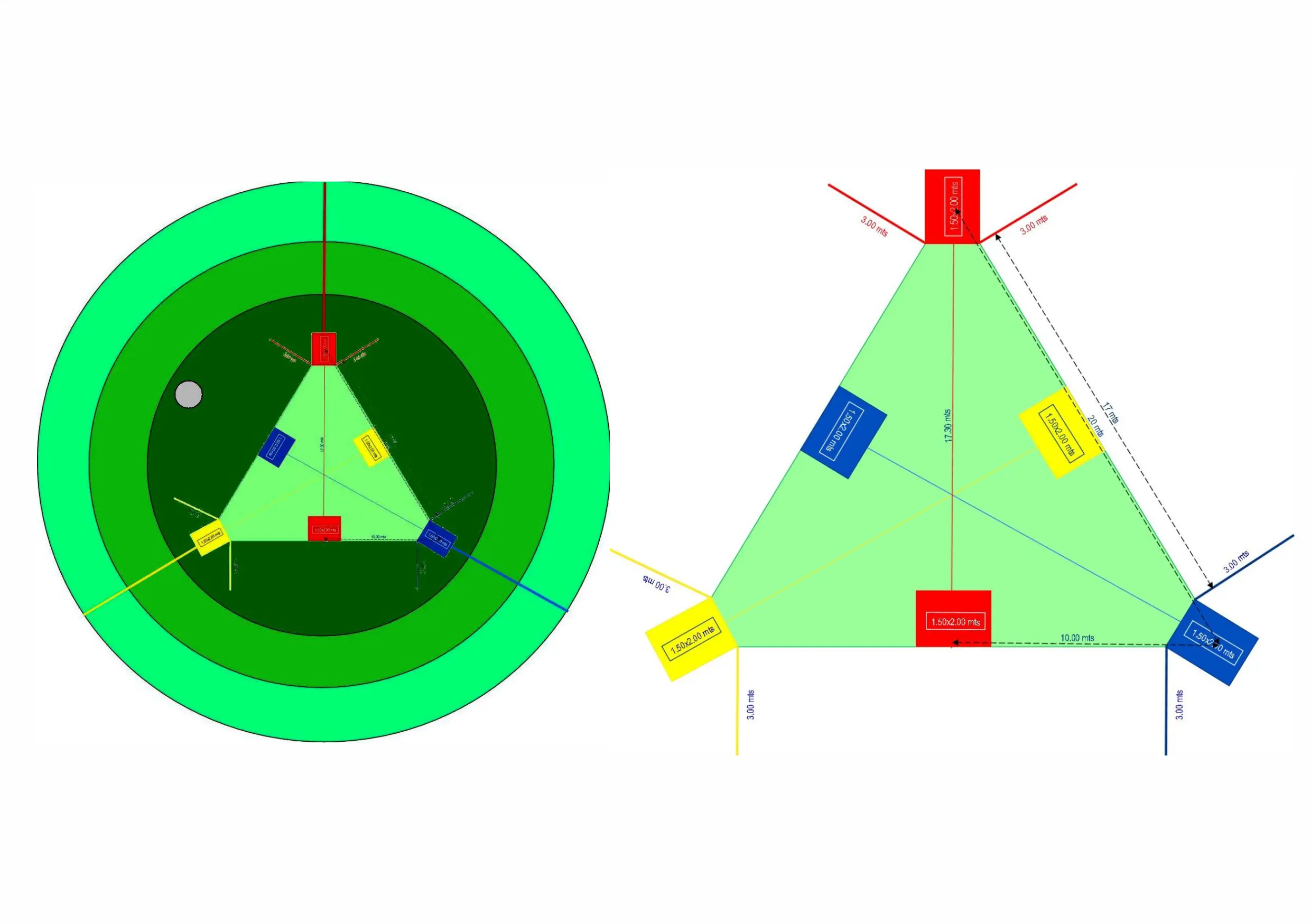
A triangular zone where throwers deliver precise, strategic balls to hitters for scoring powerful runs.
Special corner boxes inside the pitch where skilled hitters position to strike and control the ball effectively.
Marked running paths between hitter zones where players quickly sprint to complete scoring runs after striking.
Fielders positioned smartly in home, inner, and outer fields to stop runs and create dismissals efficiently.
A specially crafted wooden bat designed to strike power shots with control, speed, and long-distance precision.
A double-layered, injury-safe ball (80–120g) built for grip, bounce, durability, and smooth controlled throwing action.
A standard-sized field with well-marked zones, visible boundaries, and structured sections to ensure fair gameplay.
A specialized area near home field where keepers protect, defend goals, and coordinate the team’s defensive strategy.

Moreover, algebraic thinking fosters critical thinking, problem-solving, and analytical skills. As students work through equations and graphs, they learn to identify patterns, make connections between variables, and justify their solutions. These skills are transferable to various areas of life, including science, technology, engineering, and mathematics (STEM) fields, where algebraic thinking is essential for problem-solving and modeling complex phenomena.
The Grade 7 Math Textbook by Nelson also emphasizes the importance of communication and representation in algebraic thinking. Students learn to express their solutions using mathematical notation, graphs, and tables, which enables them to effectively convey their thinking and justify their answers. This aspect of algebraic thinking is particularly valuable, as it prepares students for more advanced mathematical studies, where clear and concise communication of mathematical ideas is crucial.
In conclusion, the introduction to algebraic thinking in Grade 7 is a pivotal moment in students' mathematical development. The Nelson Grade 7 Math Textbook provides a comprehensive and engaging approach to teaching algebraic concepts, highlighting their relevance and importance in everyday life and future mathematical pursuits. By mastering algebraic thinking, students develop critical thinking, problem-solving, and analytical skills, which serve as a foundation for success in various areas of life.
Algebraic thinking involves using variables, symbols, and equations to represent relationships between quantities. In Grade 7, students learn to simplify expressions, solve linear equations, and graph simple linear relationships. These skills enable them to analyze and model real-world situations, making informed decisions and predictions. For instance, when solving problems involving unknown values, algebraic thinking allows students to represent the unknown quantity with a variable, set up an equation, and solve for the variable.
As students progress through their mathematical journey, they encounter various concepts that build upon previously learned material. In Grade 7, one of the crucial topics introduced is algebraic thinking, which plays a vital role in developing problem-solving skills and laying the foundation for more advanced mathematical concepts. The Grade 7 Math Textbook by Nelson provides a comprehensive introduction to algebraic thinking, emphasizing its significance in everyday life and future mathematical pursuits.
The Nelson Grade 7 Math Textbook provides numerous examples and exercises that illustrate the practical applications of algebraic thinking. For example, students might encounter problems related to budgeting, where they need to represent income and expenses using variables and equations. By doing so, they develop a deeper understanding of how algebraic thinking can be used to manage personal finances and make smart financial decisions.
Moreover, algebraic thinking fosters critical thinking, problem-solving, and analytical skills. As students work through equations and graphs, they learn to identify patterns, make connections between variables, and justify their solutions. These skills are transferable to various areas of life, including science, technology, engineering, and mathematics (STEM) fields, where algebraic thinking is essential for problem-solving and modeling complex phenomena.
The Grade 7 Math Textbook by Nelson also emphasizes the importance of communication and representation in algebraic thinking. Students learn to express their solutions using mathematical notation, graphs, and tables, which enables them to effectively convey their thinking and justify their answers. This aspect of algebraic thinking is particularly valuable, as it prepares students for more advanced mathematical studies, where clear and concise communication of mathematical ideas is crucial.
In conclusion, the introduction to algebraic thinking in Grade 7 is a pivotal moment in students' mathematical development. The Nelson Grade 7 Math Textbook provides a comprehensive and engaging approach to teaching algebraic concepts, highlighting their relevance and importance in everyday life and future mathematical pursuits. By mastering algebraic thinking, students develop critical thinking, problem-solving, and analytical skills, which serve as a foundation for success in various areas of life.
Algebraic thinking involves using variables, symbols, and equations to represent relationships between quantities. In Grade 7, students learn to simplify expressions, solve linear equations, and graph simple linear relationships. These skills enable them to analyze and model real-world situations, making informed decisions and predictions. For instance, when solving problems involving unknown values, algebraic thinking allows students to represent the unknown quantity with a variable, set up an equation, and solve for the variable.
As students progress through their mathematical journey, they encounter various concepts that build upon previously learned material. In Grade 7, one of the crucial topics introduced is algebraic thinking, which plays a vital role in developing problem-solving skills and laying the foundation for more advanced mathematical concepts. The Grade 7 Math Textbook by Nelson provides a comprehensive introduction to algebraic thinking, emphasizing its significance in everyday life and future mathematical pursuits.
The Nelson Grade 7 Math Textbook provides numerous examples and exercises that illustrate the practical applications of algebraic thinking. For example, students might encounter problems related to budgeting, where they need to represent income and expenses using variables and equations. By doing so, they develop a deeper understanding of how algebraic thinking can be used to manage personal finances and make smart financial decisions.


Delhi |
National Championships
VSMarch 15, 2024
|

Mumbai |

Bangalore |
State Championships
VSApril 20, 2024
|

Chennai |
Delhi |
State Finals
3 : 1Feb 28, 2024
|
Mumbai |
Bangalore |
District Finals
2 : 0Feb 20, 2024
|
Chennai |
HAMMER BALL ASSOCIATION OF INDIA IS GOING TO BE ADD A NEW CHAPTER IN November 2025. THAT IS 2ND JUNIOR NATIONAL (U-19) CHAMPIONSHIP 2025 TO BE HELD SO...

| Pos | State | P | W | L | PTS |
|---|---|---|---|---|---|
| 1 | Puducherry | 0 | 0 | 0 | 0 |
| 2 |  Jharkhand Jharkhand | 0 | 0 | 0 | 0 |
| 3 |  West Bengal West Bengal | 0 | 0 | 0 | 0 |
| 4 |  Uttar Pradesh Uttar Pradesh | 0 | 0 | 0 | 0 |
| 5 |  Tripura Tripura | 0 | 0 | 0 | 0 |
| 6 |  Tamil Nadu Tamil Nadu | 0 | 0 | 0 | 0 |
| 7 |  Rajasthan Rajasthan | 0 | 0 | 0 | 0 |
| 8 |  Punjab Punjab | 0 | 0 | 0 | 0 |